
Song Dynasty Wedding Aesthetic in North America: A Guide to Traditional Chinese Wedding Design
By Cetusphoto — Vancouver Wedding Photography Studio
Planning a traditional Chinese wedding in North America? A photographer's guide to the rituals, done beautifully and without cliché, by a Vancouver photographer.
A note before we begin. The Song dynasty (960–1279) gave China the most refined moment in its aesthetic history — a convergence of ink, porcelain, and philosophy around four ideas: empty space, asymmetry, atmospheric mood, and harmony with nature. They are not decoration. They are a way of seeing. This is how I translate them into a wedding, and into the photographs that outlast it.

Why Song Dynasty Aesthetics Matter for Modern Luxury Weddings?
Of all the dynasties a couple might borrow from — Tang with its gold and confidence, Ming with its hardwood discipline, Qing with its dense, saturated splendour — none shapes contemporary luxury weddings as quietly, or as completely, as the Song. I don't think that is an accident. The Song was the moment painting, ceramics, calligraphy and design all leaned toward the same instinct: take away until only the essential remains, then let the essential breathe.
When couples come to me asking for something that feels like the New Chinese aesthetic but cannot say why the usual references leave them cold, this is almost always the answer. They don't want more. They want less, held with more care. The Song dynasty wedding aesthetic is the deepest, most refined foundation available for exactly that — and it gives a photographer something rare to work with: rooms that already understand silence.
The Three Core Principles of Song Dynasty Aesthetics
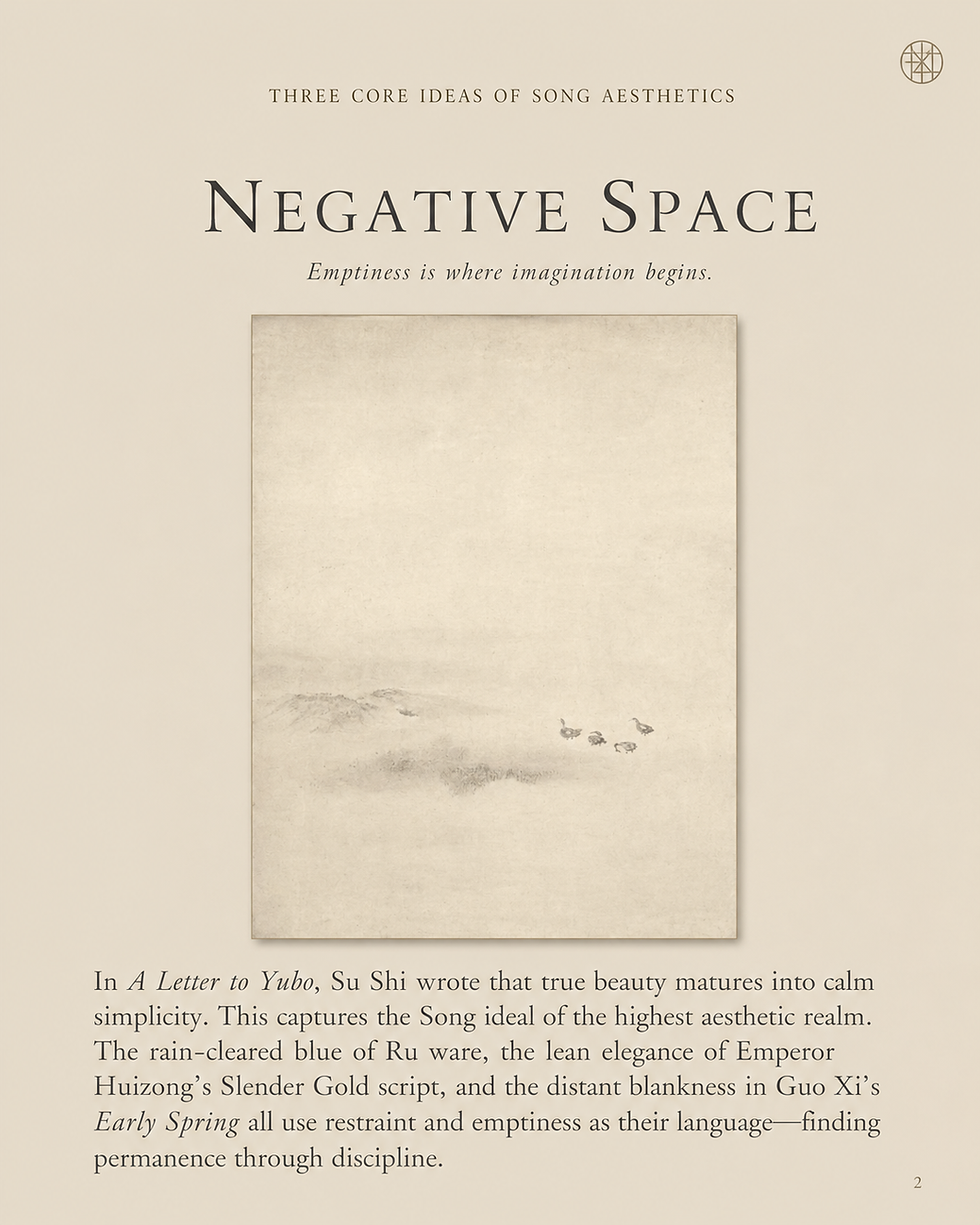
1. 留白 (Liubai) — Leaving Empty Space In Song dynasty ink painting, empty space is not "missing" — it is the most important element of the composition. A single bird on a vast blank page communicates more than a crowded landscape. The empty space is where imagination breathes.
In wedding design: Resist the urge to fill every surface. Let backdrops have negative space. Let table centerpieces breathe. Let the bride and groom stand before one perfectly placed branch instead of a wall of flowers.
2. 意境 (Yijing) — Atmospheric Mood Yijing is the most untranslatable word in Chinese aesthetics. It means "the mood that arises from a scene" — the felt atmosphere, the emotional weather, the suggestion of feeling rather than its explicit statement.
In wedding design: Focus on creating atmosphere rather than spectacle. Soft golden light, the faint sound of a guqin (Chinese zither), the smell of plum blossoms, the slow movement of silk in a breeze — these create yijing. A laser show does not.
4. 天人合一 (Tian Ren He Yi) — Unity of Heaven and Humanity Song philosophy held that the highest beauty came from harmony between humans and nature. Architecture, gardens, and design should not dominate nature — they should converse with it.
In wedding design: Prefer natural materials over synthetic. Raw wood over plastic. Real flowers over silk imitations. Use organic forms — branches, stones, water features — as central design elements rather than mass-produced decor.

The Song Dynasty Material Palette
Song aesthetics had a specific material vocabulary.

Ceramics
The Song produced some of the finest ceramics ever made. The five great kilns — Ru, Guan, Ge, Jun and Ding — were prized for their subtle glazes and their refusal of ornament. Three glazes carry the period best: celadon green porcelain (⻘瓷), the jade green that defines Song restraint; ivory toned Ding ware (定瓷), sometimes with a faint carved pattern; and the dark tea bowls (天目, tenmoku in Japanese) made for the Song tea ceremony.
HOW TO USE IT ?
Celadon or matte-white porcelain for place settings; dark tenmoku bowls for the tea ceremony itself. Nothing matched too perfectly a little variation reads as hand-made, which is the whole idea. Song furniture used dark hardwoods — huanghuali (yellow rosewood) and zitan (purple sandalwood) — in simple, unadorned forms. Bamboo was loved less for its look than its meaning: resilience, integrity, modesty.
Calligraphy & Ink Painting
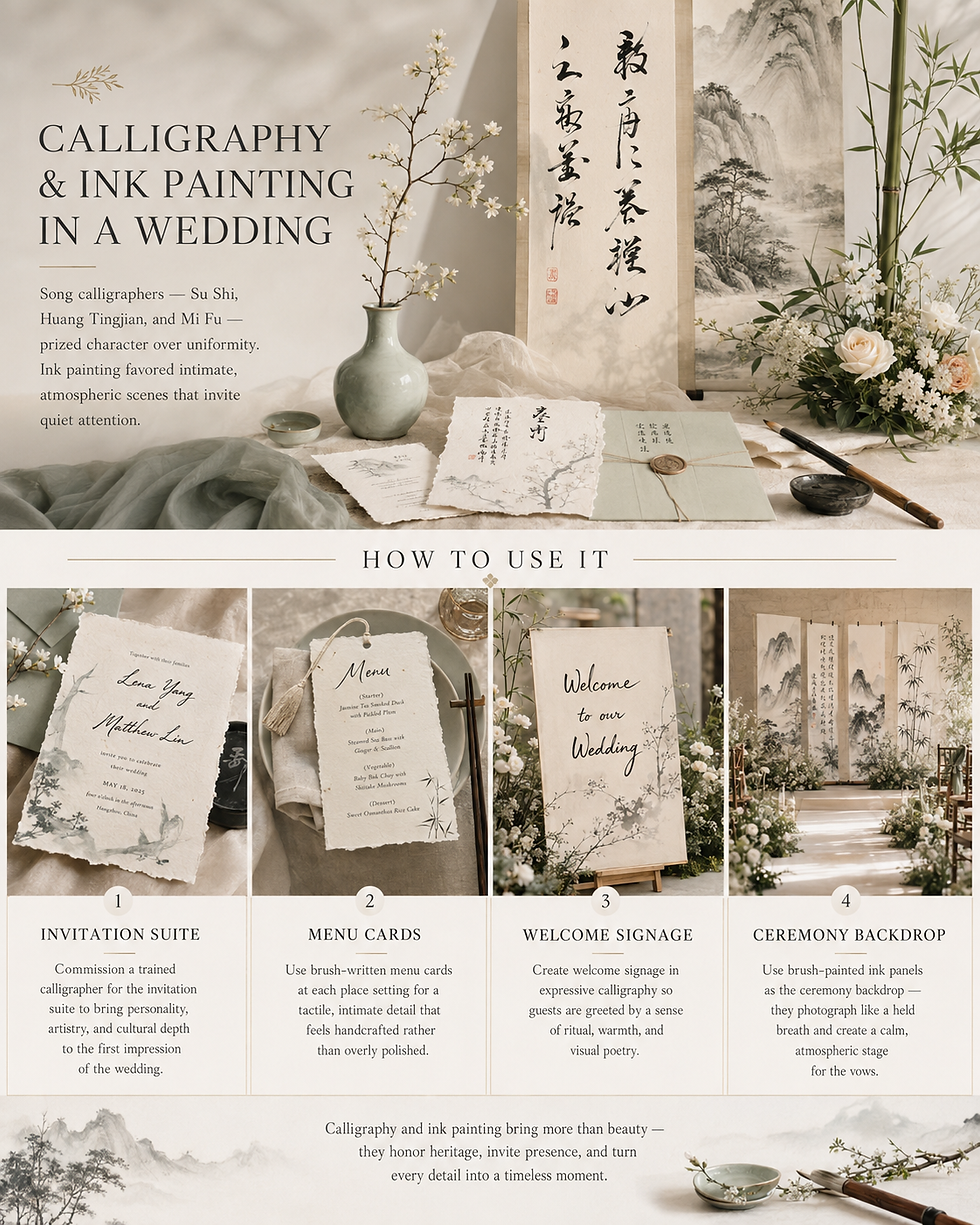
Song calligraphers — Su Shi, Huang Tingjian, Mi Fu — prized character over uniformity. Ink painting moved away from sweeping landscapes toward intimate, atmospheric pieces you could sit very close to.
HOW TO USE IT ?
Commission a trained calligrapher for the invitation suite, the menu cards and the welcome signage. Use brush-painted ink panels as the ceremony backdrop — they photograph like a held breath.

Wood & Bamboo
Song furniture used dark hardwoods — huanghuali (yellow rosewood) and zitan (purple sandalwood) — in simple, unadorned forms. Bamboo was loved less for its look than its meaning: resilience, integrity, modesty.
HOW TO USE IT ?
Dark-wood Ming-style chairs (whose lines began in Song forms), bamboo accents, natural-wood signage. Let the grain do the decorating.
The Song Dynasty Color Palette
Song aesthetics worked with a remarkably restrained palette:

The Song avoided the high-saturation reds and golds that would later define the Qing dynasty aesthetic. For a Song-inspired wedding, lean into these subtle, atmospheric colors.

How to Design Your Song-Inspired Wedding in Vancouver?
Invitations
Letterpress on warm white cardstock, brushed calligraphy in black ink, a single small persimmon-orange seal. No additional ornamentation.
Ceremony Backdrop
A single ink-painted screen (or rented antique screen) with an asymmetric floral arrangement — branches of plum, cherry, or apricot blossom placed off-center.

Tea Ceremony Setup
Hand-thrown ceramic tea set in celadon or black tenmoku glaze. Dark wood tray. A single calligraphed scroll behind the seated parents.
Reception Florals
Asymmetric, ikebana-influenced arrangements. Branches, single statement blooms, negative space. Limit each arrangement to 3–5 stem types maximum.
Tabletop
Celadon or ivory porcelain
Dark wood chargers
Brass (not gold) flatware
Raw silk runners in oat or smoke blue
Lighting
Rice paper lanterns
Candles in simple ceramic holders
Warm 2700K bulbs
No crystal chandeliers (those are Qing aesthetic)
Music
Live Guqin , Erhu , or Pipa for tea ceremony and cocktail hour
Classical Western for the ceremony if desired
90A modern DJ only after din
Planning a Traditional Chinese Wedding in North America?
For Vancouver Couples Reading This, I'm a wedding photographer based in Vancouver, and most of my work happens here — family tea ceremonies in Richmond living rooms, quiet ceremonies under the trees at VanDusen Botanical Garden, Stanley Park, gatherings across Burnaby and North Van. The Song aesthetic travels beautifully into all of them; the local plum and cherry blossom of a Sea-to-Sky spring could have been painted in 1100. So you don't need a destination to live inside this philosophy. A Song-inspired wedding can happen on Bowen Island, in a Richmond tea house, or in a single well-chosen room in the city. If that's the kind of wedding you've been imagining — restrained, atmospheric, made to be looked at slowly — I'd love to hear from you.
If you're planning a Chinese wedding, in Vancouver or anywhere in the world, I'd love to hear your story. Get in touch → Explore our portfolio → | Book a design consultation →→ DM "Elopement" to @cetusphoto on Instagram — fastest reply, usually within 24 hours
Questions Couples Ask

A note on imagery: some of the photographs in this article were generated with AI to illustrate the aesthetics described here — they're visual references, not real weddings or client work. Everything else across our blog and portfolio is genuine photography, shot by our studio at real weddings.


Comments